
Healthcare Regulatory Compliance 2026: How Multi-Specialty Practices Avoid Costly Penalties By Within EHR Clinical Intelligence Team Published: March 23, 2026 | Updated: March 23, 2026 | ⏱️ 12 min read Category: Regulatory Compliance | Blog › Practice Management › EHR Compliance & Risk
If you practice medicine in 2026 and regulatory compliance still feels like a background administrative function something your billing team handles, something your EHR vendor manages, something that affects other practices then you are carrying risk you may not fully see yet.
Healthcare regulation is not a static body of rules that practices absorb once and file away. It is an actively enforced, continuously evolving body of law that is currently generating record-setting penalty activity, expanding to cover practice sizes that previously flew under the enforcement radar, and adding new violation categories that many clinicians have never heard of until they receive an audit notice.
For physicians and clinicians working across multiple specialties, the challenge is compounded. Every specialty brings its own documentation requirements, coding standards, payer rules, and compliance checkpoints. Managing that complexity manually or relying on an EHR that was not built for it is not just inefficient. It is a penalty risk hiding in plain sight.
This guide is written for multi-specialty clinicians, practice administrators, and IT staff who want a clear understanding of the regulatory environment they are operating in right now, the specific compliance risks that are most actively enforced in 2026, and how Within EHR embeds compliance into the daily workflows your team already uses so staying current does not require a separate process.
The Regulatory Environment in 2026 Is More Actively Enforced Than at Any Prior Point in U.S. Healthcare History
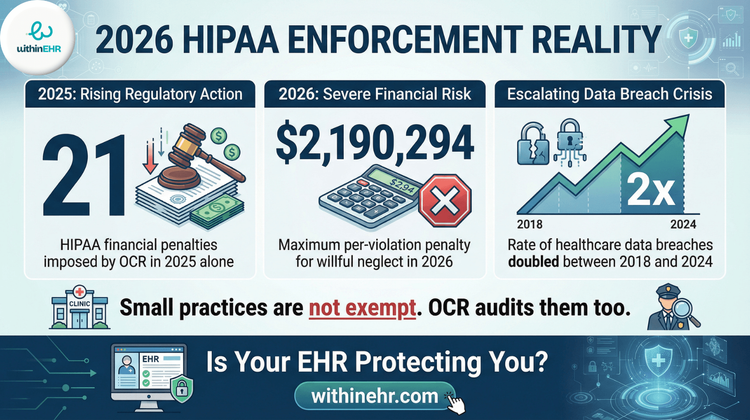
This is not an overstatement. The enforcement numbers behind it are specific and current. OCR enforcement increased significantly in 2025, with 21 financial penalties imposed and in 2026, OCR is continuing its HIPAA Right of Access enforcement initiative while expanding its Risk Analysis Initiative to include risk management, meaning that how organizations act on their risk analyses now matters as much as whether they have conducted one.
The penalties for HIPAA violations in 2026 include civil monetary penalties ranging from $145 to $2,190,294 per violation, depending on the level of culpability with the maximum penalty for willful neglect violations increasing to $2,190,294 per violation as of January 28, 2026.
Between 2018 and 2024, the rate of healthcare data breaches involving 500 or more records doubled from one to two per day. Enforcement in 2025 may break previous records, with OCR announcing 20 settlements and financial penalties by September alone.
OCR has settled or imposed civil monetary penalties in more than 50 HIPAA violation cases as of January 2026 and OCR's current enforcement priorities clearly point toward a future in which risk analysis and risk management are inseparable, documented, and actionable.
For multi-specialty practices, the critical insight embedded in these numbers is this: practice size is no longer a compliance shield. HIPAA violations in 2026 are no longer isolated compliance issues small practices face active monitoring and audits just as large hospitals do, and regulators now expect healthcare providers to actively demonstrate compliance rather than simply claim adherence.
The penalty exposure your practice faces in 2026 is not determined by your size. It is determined by the quality of your compliance infrastructure.
The Four Penalty Categories Every Multi-Specialty Practice Must Understand in 2026
1- HIPAA Violations The Most Familiar and Most Frequently Triggered: HIPAA penalties range from $100 to $50,000 per violation depending on the level of negligence, with annual maximums reaching $1.5 million per violation category. The Intake The most commonly cited violations in clinical settings are not dramatic security failures they are structural gaps that accumulate quietly over time. Unauthorized access to patient records. Failure to encrypt electronic protected health information. Missing or outdated Business Associate Agreements. Inadequate access controls. Insufficient audit logging.
OCR's recent enforcement initiatives go beyond merely checking that a risk analysis exists. OCR now evaluates risk management and mitigation meaning that how organizations act on their analyses matters. Regulators are increasingly associating weak execution and stagnant risk remediations with lapses that lead to breaches and unauthorized disclosures.
A ransomware attack affecting 14,273 patients recently led to a $90,000 settlement not because the attack occurred, but because the practice had never conducted a formal risk analysis. The violation was not the breach. The violation was the absence of the compliance infrastructure that might have prevented it.
2- Information Blocking A Newer Penalty Category With Immediate Financial Consequences: Information blocking is the area where many multi-specialty clinicians are most unknowingly exposed and where the consequences arrived with less warning than any other current enforcement priority.
Since July 31, 2024, healthcare providers face severe disincentives if found engaging in information blocking defined as any practice that unreasonably interferes with the access, exchange, or use of electronic health information.
MIPS clinicians who have committed information blocking will not be considered meaningful EHR users and will receive a zero score in the MIPS Promoting Interoperability performance category which is typically 25% of the total MIPS score meaning a clinician can earn a maximum total MIPS score of only 75 points, which in most cases results in a negative payment adjustment.
A hospital that unreasonably impedes data sharing could lose 75% of its Medicare annual payment update. A physician practice could receive a zero score in the Promoting Interoperability category of MIPS, directly hurting reimbursement.
For practices using EHR systems without a compliant FHIR-based patient portal, non-standard data formats, or restrictive records release workflows, information blocking exposure is not hypothetical. It is structural and it is actively enforced.
3- MIPS Payment Adjustments The Quietly Compounding Financial Penalty: For Medicare eligible clinicians today, using certified EHR technology and meeting the Promoting Interoperability requirements within MIPS is required to avoid negative payment adjustments of up to 9% of Medicare Part B reimbursements.
What makes MIPS adjustments uniquely damaging is their compounding nature. They are applied two years after the performance period meaning clinicians who failed to capture and submit required quality data points in 2024 are facing reduced reimbursements right now in 2026. The most common reason practices receive negative MIPS adjustments is not clinical underperformance. It is failure to consistently capture and submit the required data throughout the performance year a documentation workflow problem, not a care quality problem.
For high-volume Medicare practices, a 9% negative adjustment represents a six-figure annual revenue reduction that accumulates year over year for as long as the underlying compliance gap persists.
4- Coding and Documentation Penalties The Audit Risk That Builds Silently: E/M coding inaccuracies, underdocumented medical necessity, and upcoding patterns create CMS and OIG audit exposure that can result in repayment demands, False Claims Act liability, and in severe cases, exclusion from federal healthcare programs. For multi-specialty practices, this risk is amplified by the fact that different specialties operate under different documentation standards and a single EHR with generic templates may not adequately support defensible documentation across all of them.
The AMA's revised E/M coding guidelines, implemented in 2021 for office visits and expanded in 2023 for inpatient services, fundamentally changed how E/M levels are selected and documented. Many clinicians are still documenting under old frameworks generating both underpayment and audit exposure simultaneously, with neither visible until a payer or auditor makes it visible.
Why Compliance Complexity Is Outpacing Manual Workflows in Multi-Specialty Practices
Regulatory updates affect different clinical departments differently. Orthopedics faces different coding changes than behavioral health, which operates under different documentation standards than primary care, which faces different interoperability requirements than cardiology. A practice-wide compliance memo sent by email addresses none of those specialty-specific gaps. It just gives you documentation that you sent the memo.
For IT staff, the compliance challenge has a technical dimension that is increasingly difficult to manage on legacy infrastructure. ONC interoperability rules require FHIR-based data exchange capabilities. HIPAA Security Rule requirements demand encryption standards, access controls, and audit logging that many older EHR platforms cannot reliably deliver. Staying compliant is inseparable from staying current and staying current requires a platform that is actively maintained, continuously updated, and aligned with federal healthcare IT mandates on a regulatory calendar, not whenever the next major version ships.
The 7-Step Regulatory Readiness Protocol for Multi-Specialty Practices
Step 1 — Establish Specialty-Specific Regulatory Monitoring Regulatory changes rarely arrive with sufficient advance notice, and no single source captures all updates relevant to a multi-specialty practice. Build a monitoring framework that tracks updates from CMS, ONC, HHS OCR, the AMA, and relevant specialty societies simultaneously. Assign clear ownership for monitoring and translating changes into workflow updates and confirm that your EHR vendor actively pushes platform updates aligned with regulatory timelines. The common mistake here is treating regulatory monitoring as a practice-wide function when it must be specialty-specific.
Step 2 — Conduct and Document an Annual HIPAA Security Risk Analysis HIPAA's Security Rule requires a formal risk analysis but most practices conduct one at implementation and never revisit it. An annual assessment must evaluate encryption standards for data at rest and in transit, user access controls and role-based permissions, audit log completeness and retention, BAA currency with all business associates, and mobile device and remote access security. Document the assessment, remediate identified gaps, and retain the documentation OCR's audit protocol specifically requests evidence of ongoing risk analysis activity, not just an initial assessment on file.
Step 3 — Align Documentation Templates with Current E/M Guidelines Confirm that your EHR's documentation templates reflect current AMA E/M guidelines and that medical decision-making prompts align with updated complexity criteria. Your coding workflow should support accurate level selection without requiring clinicians to manually cross-reference policy updates at the point of care. If templates were built before the 2021 or 2023 guideline updates and have never been revised, every E/M note completed under those templates is potential audit exposure.
Step 4 — Implement EHR-Integrated Prior Authorization Tracking Prior authorization requirements have expanded significantly across commercial and government payers in 2026. In multi-specialty practices, authorization requirements vary by specialty, service type, and payer making manual tracking unsustainable at scale. EHR-integrated authorization tracking must identify required authorizations at scheduling, monitor status in real time, and alert clinical and administrative staff before authorizations expire. Authorization failures that cause denied claims are entirely preventable with the right workflow infrastructure.
Step 5 — Embed MIPS Quality Measure Documentation Into the Clinical Encounter The most common reason practices receive negative MIPS adjustments is failure to capture required data points consistently throughout the performance year not inadequate clinical performance. Embed MIPS quality measure documentation directly into encounter workflows so data capture happens automatically at the point of care. The year-end data collection scramble that leads to incomplete submissions and negative payment adjustments is a workflow problem, not a clinical one and it is entirely solvable.
Step 6 — Verify Information Blocking Compliance Before Your Next OIG Referral Confirm that your EHR supports a FHIR-compliant patient portal, that records are available for patient access within regulatory timeframes, and that your data sharing workflows do not inadvertently create information blocking exposure through access restrictions, non-standard data formats, or delayed release policies. Health care providers have been required to comply with the Information Blocking Rule since April 5, 2021. Disincentives have been actively applied since July 31, 2024. If your EHR cannot support compliant electronic health information sharing, that exposure exists right now.
Step 7 — Maintain Audit-Ready Documentation as a Daily Clinical Discipline Regulatory audits require rapid production of complete, accurate clinical and administrative documentation. Practices that maintain audit readiness continuously are those that treat documentation standards as a daily operational requirement not an emergency response triggered by an audit notice. This means encounter notes finalized within regulatory timeframes, signed consent and authorization records, current BAAs with all business associates, evidence of annual HIPAA training for all staff, and a documented risk analysis on file.
Want to see how Within EHR embeds all seven of these compliance requirements into your daily clinical workflow?
Our free demo is built around your specific specialty mix, patient population, and regulatory obligations not a generic product walkthrough. Schedule your free compliance demo today → Click Here
How Within EHR Supports Multi-Specialty Regulatory Compliance
For clinicians and physicians, encounter documentation templates are aligned with current AMA E/M guidelines and updated in response to regulatory changes so documentation accurately reflects care complexity and supports defensible coding decisions without requiring clinicians to manually cross-reference policy updates.
Specialty-specific templates ensure that each clinical department operates under documentation standards appropriate to its regulatory environment not a one-size-fits-all template that satisfies no specialty adequately.
For practice administrators and compliance officers, Within EHR provides continuous HIPAA Security Rule alignment with end-to-end encryption, role-based access controls, comprehensive audit logging, and Business Associate Agreement management built into the platform architecture. Information blocking compliance is supported through a fully FHIR-compliant patient portal and standardized data exchange capabilities that meet ONC requirements. Within EHR's regulatory update process ensures the platform evolves in step with the compliance landscape so your practice is never caught operating under yesterday's rules.
For IT staff, Within EHR eliminates the infrastructure burden of maintaining compliance on aging on-premise systems. As a cloud-based platform built on current security standards and actively maintained against evolving HIPAA and ONC requirements, Within EHR gives technical teams confidence that the clinical platform is not a source of regulatory exposure freeing resources for strategic priorities rather than compliance remediation.
Frequently Asked Questions:
A: Healthcare regulations change continuously CMS updates Medicare billing and quality reporting requirements annually, ONC issues ongoing interoperability guidance, and HHS OCR regularly updates HIPAA enforcement priorities.
Q: What are the most common HIPAA violations that affect clinicians directly?
A: The compliance issues most often alleged in HIPAA complaints are impermissible uses and disclosures of protected health information, lack of safeguards for PHI, lack of patient access to their protected health information, lack of administrative safeguards for electronic PHI, and use or disclosure of more than the minimum necessary protected health information.
Q: What is information blocking and how could my practice be at risk?
A: Information blocking refers to any practice that unreasonably restricts patient access to their electronic health information, as defined under the 21st Century Cures Act. Practices using EHR systems without a compliant patient portal, non-standard data formats, or restrictive records release workflows may be inadvertently blocking information.
Q: How does Within EHR help with MIPS reporting for multi-specialty practices?
A: Within EHR integrates CMS MIPS quality measure documentation directly into encounter workflows for each specialty capturing required data points at the point of care. This eliminates the manual data aggregation process that leads to incomplete submissions and negative payment adjustments and provides administrators with real-time visibility into performance year progress across all reporting clinicians.
Q: Do small practices really face HIPAA audits in 2026?
A: Yes. Small practices face active monitoring for HIPAA compliance, and authorities conduct audits on them just as they do for large hospitals. HIPAA violations in 2026 are no longer isolated compliance issues affecting only large health systems they reflect how well any clinic protects patient trust and manages risk.
Ready to streamline your practice?
See how Within EHR's AI-native tools can transform your workflow.
Book a demo