
How AI Assistants Support Front Desk Operations in Mental Health Practices
Mental health practices are under more front desk pressure than ever before and in 2026, that pressure has reached a breaking point for many administrative teams.
Phones ring without stopping. Appointments are booked, canceled, and rescheduled throughout the day. Insurance eligibility must be verified before every visit. Intake forms arrive incomplete or not at all. And through all of it, front desk staff are expected to give every patient a calm, supportive first impression the kind of impression that builds trust before a single clinical encounter begins.
That operational reality is exactly why AI front desk tools are no longer a future consideration for mental health practices. They are a present-day competitive and financial necessity.
This guide explains what AI front desk tools can genuinely do for mental health practices in 2026, where the real risks lie, what the ROI evidence actually shows, and what compliance requirements every practice must address before adopting any solution.
Why the Mental Health Front Desk Is Uniquely Difficult to Manage
Mental health practices deal with recurring weekly appointments that require pattern-level thinking rather than one-off scheduling. A therapy patient may come in every Tuesday at 3 pm for eighteen months. Generic platforms treat each appointment as independent but purpose-built systems allow scheduling of recurring series, apply the same billing rules automatically, and flag when a patient misses a session in their established pattern.
That distinction matters enormously when a missed session is both a revenue gap and a potential clinical signal.
Beyond scheduling complexity, mental health patients are among the most privacy-sensitive populations in all of healthcare. Every phone call, every SMS reminder, every intake form exchange involves protected health information governed not just by HIPAA but potentially by 42 CFR Part 2 for patients with co-occurring substance use disorder diagnoses. A generic scheduling chatbot does not understand that distinction. The consequences of getting it wrong are not just operational they are legal.
And then there is the access problem. Mental health patients frequently reach out during evenings, weekends, and moments of emotional urgency. Approximately 11% of all patient communications happen outside standard business hours. When a practice cannot respond until the next morning, that patient may disengage entirely or worse, not receive support at a moment when support matters most.
What AI Front Desk Tools Can Actually Do in 2026
Around-the-Clock Scheduling Without Adding Headcount The most immediate operational benefit of an AI front desk system is 24/7 scheduling availability. Patients can request, book, confirm, or reschedule appointments through phone, SMS, web chat, or online patient portal forms without waiting for office hours and without creating additional work for staff.
Online appointment scheduling tools with AI-powered interfaces allow patients to book, reschedule, or cancel appointments without phone calls and when paired with automated reminders, these tools reduce no-shows and ease the burden on front desk staff by lowering both inbound and outbound call volume.
Reducing No-Shows With Real Numbers Behind It No-shows are one of the most direct and financially damaging operational problems in behavioral health. If a clinic sees 150 sessions per week and has a 15% no-show rate the industry average that is 22 missed sessions every single week. At $150 per session, that is over $170,000 annually in unrecaptured revenue.
AI-powered reminder and rescheduling workflows attack this problem at every stage. Rather than sending the same static reminder to every patient at the same time, modern AI systems adapt timing, channel, and message content based on patient behavior patterns making confirmation more likely and rescheduling frictionless when a patient cannot attend.
AI reduces no-show rates by up to 30% through automated reminders, self-rescheduling, and pre-visit engagement sequences. One hospital reduced no-shows by 28% over seven months and captured $804,000 in additional revenue. The mechanism is straightforward: 75% of patients say online rescheduling would encourage attendance AI provides this capability 24 hours a day, 7 days a week.
Digital Intake That Reaches Clinicians Before the First Session Digital intake is one of the highest-value front desk automations available to mental health practices and one of the most underutilized.
When patients complete demographic details, consent forms, insurance information, intake questionnaires, and clinical screening tools before their appointment rather than at check-in, the operational and clinical benefits compound. Front desk staff no longer spend time collecting and manually entering information that the patient could have provided the night before. Clinicians arrive at the first session with presenting concerns, medication history, prior treatment background, and screening scores already documented in the chart.
For mental health specifically, pre-visit PHQ-9 and GAD-7 completion means the clinician enters the room already oriented to the patient's self-reported symptom severity not discovering it for the first time during the intake conversation. That is a clinical efficiency gain, not just an administrative one.
Insurance Eligibility Verification That Happens Before the Problem Insurance eligibility failures are one of the most preventable denial triggers in behavioral health billing and most of them happen because eligibility was never checked before the appointment, or was checked manually under time pressure and recorded inaccurately.
AI front desk systems perform real-time eligibility verification automatically at the time of scheduling or in the 24 to 48 hours before the appointment. Coverage issues are flagged before the patient arrives, giving billing staff time to resolve problems before they become denied claims rather than after.
For mental health practices already managing denial rates of 15 to 25%, pre-appointment eligibility verification is not a convenience feature. It is revenue cycle protection built into the scheduling workflow itself.
Two-Way Patient Communication That Actually Gets Responses One-way reminders are no longer sufficient for the patient population mental health practices serve. Patients want to reply, ask questions, confirm details, and communicate through the channel that works best for their life SMS, email, patient portal messaging, or voice.
AI-powered communication platforms manage this across all channels simultaneously handling appointment confirmations, answering routine scheduling questions, following up on incomplete intake, routing prescription refill requests, and re-engaging patients who have lapsed from regular care. All of it happens automatically, without consuming front desk staff time on interactions that do not require human judgment.
Where AI Cannot Replace Human Judgment at the Front Desk
AI front desk tools should not be used to manage emotionally complex patient conversations, handle crisis-related disclosures, navigate nuanced insurance advocacy situations, or make any determination that requires understanding the whole person behind the appointment request.
In 2026, AI-driven systems can analyze patterns in patient data appointment history, no-show rates, utilization patterns to identify individuals who may be at higher risk of crisis or escalation. If a patient has missed multiple appointments, has had recent emergency department visits, or shows patterns suggesting increasing acuity, an AI system can flag that individual as needing more immediate attention.
The Real ROI of AI Front Desk Tools What the Evidence Shows
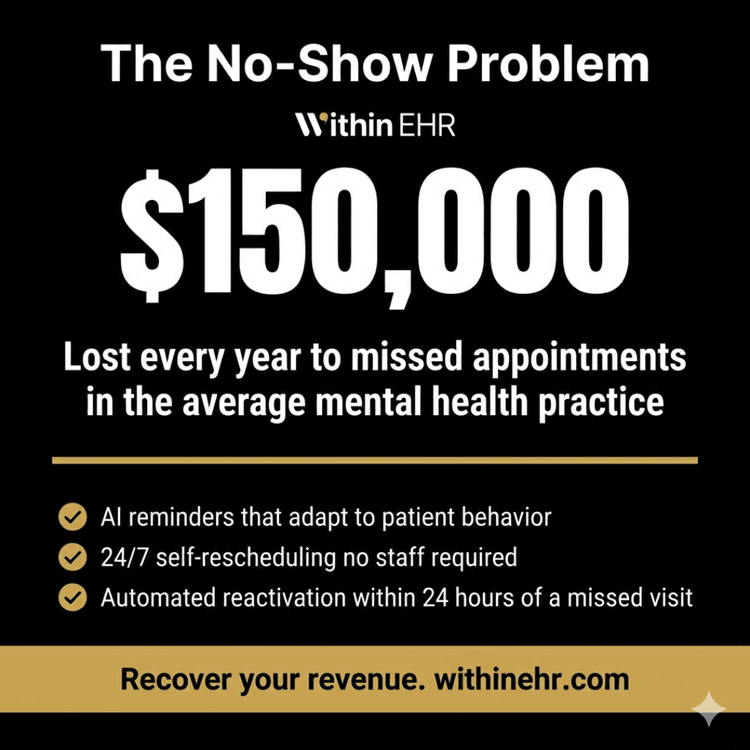
No-shows cost the average private practice $150,000 per year. AI reminder and rescheduling systems typically produce measurable no-show reduction within 30 to 60 days of implementation. The 38% no-show reduction figure materializes over 60 to 90 days as the system learns patient behavior patterns and optimizes its approach. The ROI is usually obvious within the first month.
El Rio Health, a federally qualified health center in Arizona, reduced no-show rates by 32% and increased monthly revenue by $100,000 using AI-powered appointment reminders with front desk staff receiving short, hands-on training that made adoption seamless from day one.
The cost comparison between AI tools and traditional staffing solutions reinforces the financial case. A full-time medical receptionist costs $3,000 to $4,000 per month in salary alone before benefits, training, and turnover costs. Robust AI front desk software for healthcare settings typically runs $129 to $600 per month. For multi-provider practices managing high call and scheduling volume, that differential scales significantly in favor of AI because the technology handles any volume without additional hiring.
HIPAA and Compliance Requirements Every Practice Must Address
A signed Business Associate Agreement must be in place with every AI front desk vendor before any patient data enters their system. This is not optional and it is not a formality it is a HIPAA legal requirement that applies to every vendor whose tool handles scheduling data, patient communication, or intake information.
All patient communications managed through AI tools SMS reminders, portal messages, intake forms, call recordings must be encrypted in transit and at rest. Verify this technically through vendor documentation, not just through marketing claims.
For mental health practices treating patients with co-occurring substance use disorders, AI communication tools must be configured to honor 42 CFR Part 2 restrictions specifically, avoiding disclosure of SUD-related information through automated messages that are not covered by appropriate patient consent. Most general-purpose scheduling AI tools are not built with this requirement in mind. It must be explicitly evaluated and configured before any SUD-related patient data enters the workflow.
AI Front Desk Readiness Checklist for Mental Health Practices
Scheduling and Availability
☐ AI scheduling tool is available 24/7 for patient self-booking via phone, web, and SMS
☐ Recurring appointment series management is supported natively
☐ Predictive no-show detection triggers proactive rescheduling outreach
☐ Waitlist management fills cancelled slots automatically without manual staff intervention
☐ Post-no-show reactivation messages are configured and sent within 24 hours of a missed visit
Patient Communication
☐ Two-way conversational messaging is supported patients can reply and receive real-time confirmation
☐ Appointment reminders are multichannel SMS, email, and portal based on patient preference
☐ Automated re-engagement campaigns are active for patients lapsed from regular care
☐ Crisis escalation protocols are documented defining exactly when AI routes to human staff
Intake and Insurance
☐ Digital intake forms are completed by patients before the appointment not at check-in
☐ Intake data flows directly into the EHR no manual re-entry required
☐ Real-time insurance eligibility verification runs automatically before every appointment
☐ Eligibility failures generate automatic alerts to billing staff before the patient arrives
HIPAA and Compliance
☐ Signed BAA is in place with every AI front desk vendor
☐ All patient communications are encrypted in transit and at rest
☐ Audit trail is active for all AI interactions involving patient data
☐ Shadow AI policy is established all front desk AI tools are IT-approved and BAA-covered
☐ 42 CFR Part 2 restrictions are configured in communication tools for SUD patient records
EHR Integration
☐ AI front desk tools are integrated natively with your EHR no manual data transfer required
☐ Scheduling data, intake forms, and communication logs sync to the patient record automatically
☐ AI front desk performance metrics are visible in a reporting dashboard no-show rates, scheduling conversion, eligibility failure rates
The Bottom Line: Your Front Desk Is Your Practice's First Impression and Its Financial Foundation
AI front desk tools solve the problems that are solvable through automation so your human team can solve the ones that are not.
The practices that get this right in 2026 will run leaner, book more consistently, collect more reliably, and retain their staff longer. The ones that ignore it will keep managing a front desk crisis one phone call and one no-show at a time.
Your patients deserve a first impression that reflects the quality of care they are about to receive. AI front desk technology is one of the most practical, most affordable, and most immediately measurable ways to deliver it.
How Within EHR Supports AI-Powered Front Desk Operations
The front desk and the clinic operate as one connected system not two separate tools requiring manual coordination between them. Schedule a free Front Desk Automation Demo with Within EHR → Click Here
Frequently Asked Questions:
Q: Will AI replace our front desk staff?
A: No, and the evidence is clear on this. AI works best when it automates repetitive, high-volume administrative work scheduling, reminders, intake collection, eligibility checks so that human staff can focus on the interactions that require empathy, judgment, and clinical awareness.
Q: Can AI actually reduce no-shows in behavioral health?
A: Yes, with documented results behind it. AI reduces no-show rates by up to 30% through automated reminders, self-rescheduling, and pre-visit engagement sequences. Bluebrix The mechanism is friction reduction making it easier for patients to confirm or reschedule than to simply not show up.
Q: Is AI front desk technology HIPAA-compliant?
A: It can be but compliance is never automatic. Every vendor must provide a signed BAA before any patient data enters their system. All communications must be encrypted. Audit trails must be active. And for mental health practices specifically, 42 CFR Part 2 compliance requirements must be explicitly evaluated and configured for any patient population that includes SUD diagnoses.
Q: What happens when a patient contacts the practice in distress?
A: This is where escalation protocol configuration is non-negotiable. AI front desk systems must be configured to detect urgency signals and immediately route those contacts to a human-defined escalation pathway an on-call clinician, crisis line, or designated staff member rather than handling them through automated scheduling responses.
Q: Why do mental health practices need specialized front desk automation?
A: Because behavioral health practices manage recurring appointments, privacy-sensitive communications, 42 CFR Part 2 compliance obligations, and emotionally complex patient interactions that general medical scheduling tools are not designed to handle.
Ready to streamline your practice?
See how Within EHR's AI-native tools can transform your workflow.
Book a demoYou May Also Like
No related articles available at the moment.
Browse all articles